
In a landmark geotechnical engineering undertaking, the expansion of the Trans-Alpine Corridor in central Europe has turned to SupAnchor's innovative hollow bar anchor technology to secure unstable slopes and foundation structures amid exceedingly difficult ground conditions. The $2.4 billion project, spanning a 14-kilometer stretch through the foothills of the Alps, includes twin highway tunnels, deep cuttings, and a series of retaining walls up to 25 meters high. With soils ranging from glacial tills to weathered phyllites, and groundwater seeping through fracture networks, the risk of instability was acute. Conventional anchoring methods involving cased drilling and post-installation grouting were deemed too slow and environmentally disruptive, given the need to minimize vibration and noise in a biodiverse corridor. Instead, the project consortium selected the drill-and-grout bolt technology from SupAnchor, a decision that is proving instrumental in keeping the project on schedule and within budget.
The Trans-Alpine Corridor upgrade is a key part of the European Union's TEN-T network, designed to improve connectivity between northern and southern Europe. The section under construction passes through an area with a long history of landslides and rockfall. Site investigations revealed a complex stratigraphy: up to 10 meters of loose, water-saturated colluvium overlying fractured schist and gneiss. The design called for extensive slope reinforcement, including soil nailing for shallow stabilization and deep anchor systems for the retaining walls. The geotechnical reinforcement system had to offer immediate load-bearing capacity after installation and be adaptable to varying ground conditions without requiring multiple construction phases.
Given these constraints, the self drilling anchor system emerged as the optimal choice. Unlike traditional post-grouted anchors, the hollow bar anchor serves as the drilling rod, casing, and tendon simultaneously. The drill-and-grout bolt technique eliminates the risk of borehole collapse in loose soils and ensures a full-column grout-to-ground bond. This not only provides high pull-out resistance but also reduces drilling time by at least 40%, a critical factor in an environment where weather windows are limited. The project's geotechnical engineer, Dr. Markus Lehner, noted: "We needed a reliable system that could handle everything from boulders to soft ground without switching methods. The hollow bar anchor from SupAnchor delivered exactly that, with a simplicity that reduced our equipment footprint significantly."
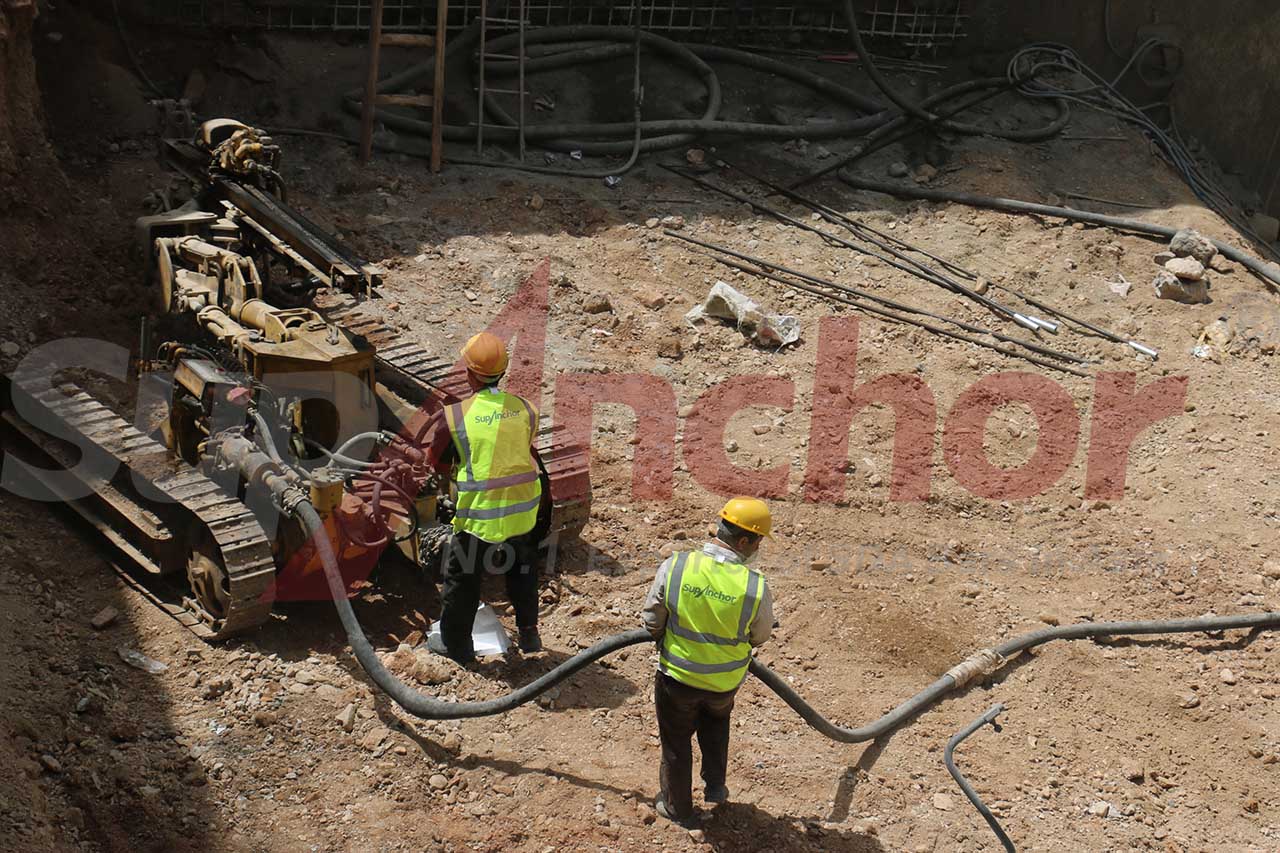
The construction site photograph illustrates a typical installation sequence for a self drilling anchor bolt. Workers are seen guiding a 32mm hollow bar, equipped with a sacrificial carbide bit, into the slope face using a hydraulic rotary-percussive drill. Cement grout is injected through the hollow core as the anchor advances, creating a reinforced column that consolidates the surrounding ground. In the image, the anchor is at a shallow angle into a steep excavation, part of a series of rows designed to stabilize a 18-meter-high retaining structure. Spacing varied between 1.5 and 2.5 meters, with anchor lengths from 6 to 12 meters, tailored to the required embedment into competent rock.
SupAnchor's anchor bolt system for geotechnical engineering is characterized by high-strength steel with a harmonious thread profile. The project utilized anchors with the following specifications:
| Parameter | Specification |
|---|---|
| Anchor Type | Self Drilling Anchor Bolt (Hollow Bar) |
| Nominal Diameter | 32 mm |
| Tensile Strength | 1035 MPa |
| Yield Strength | 950 MPa |
| Elongation | ≥ 6% |
| Length | 6 m, 9 m, 12 m (custom available) |
| Corrosion Protection | Hot-dip Galvanized (min. 85 µm coating) |
| Thread Type | Left-hand rope thread |
| Coupler | Full-strength, with locking segment |
| Drill Bit | Cross-cut tungsten carbide |
The high tensile strength of the hollow bar allowed engineers to use a 32mm diameter anchor to achieve design loads exceeding 400 kN, thus reducing the number of anchors needed per square meter. The hot-dip galvanized coating, compliant with ISO 1461, provides robust defense against the corrosive environment caused by acidic soil and high moisture. The left-hand thread design simplifies coupling and prevents unscrewing during drilling, a common issue in fractured rock. These features are a testament to why SupAnchor is recognized as a premier ground anchor bolt factory, offering SDA bolt factory direct supply to ensure consistent quality and timely delivery.
Traditionally, the installation of ground anchors in such conditions would require casing to prevent hole collapse, followed by insertion of a tendon and pressure grouting. This multi-step process is time-consuming, generates slurry waste, and often results in poor grout coverage if groundwater purges the hole. The self drilling anchor for retaining walls, by contrast, integrates all steps into one continuous operation. As a leading soil nail system manufacturer, SupAnchor has perfected the hollow bar to function as a drill-and-grout bolt, drastically simplifying logistics. For the Trans-Alpine project, the switch to self drilling anchors reduced the planned installation time by nearly 50%, allowing the earthworks to proceed ahead of schedule.
Another significant advantage is the superior load transfer mechanism. The ground stabilization anchor system develops a rough, grout-filled thread along its entire length, creating a mechanical interlock with the ground that surpasses smooth bar anchors. This results in higher pull-out resistance, especially in granular soils. The system can also be installed at any angle, enabling precise placement behind the theoretical failure plane. Environmental benefits were also notable: no permanent casing left in the ground means less steel waste, and the grout mix used was adjusted to contain low-alkali cement to minimize ecological impact. The project's sustainability officer commented, "SupAnchor's method reduced our carbon footprint per anchor by 22% compared to conventional cased methods."
The successful application of this anchor bolt in the Trans-Alpine Corridor reflects a broader shift in civil engineering towards more resilient and adaptable construction techniques. Aging infrastructure in Europe and North America demands efficient retrofitting solutions, and the self drilling bolt for civil engineering is increasingly specified for bridge abutments, tunnel portals, and landslide mitigation. Meanwhile, the mining industry relies on similar technology for rock reinforcement; the rock bolt for underground mining applications often shares the same hollow bar DNA, providing immediate support in development headings. Furthermore, the growing emphasis on sustainable construction is driving demand for systems that use less cement and steel per linear meter of support—criteria where hollow bar anchors excel. SupAnchor's products are thus at the intersection of multiple high-growth sectors.
In particular, the micropile hollow bar anchor configuration is gaining traction for deep foundation repair and seismic upgradation. Urban construction sites with limited headroom benefit from this technology, as it can be installed with compact rigs and minimal vibration. The SDA bolt factory direct supply model ensures that project planners can source anchors directly from the manufacturer, bypassing supply chain uncertainties. This reliability has become a cornerstone for large-scale projects where delays due to anchor shortages can derail entire schedules.
Behind every anchor leaving the SupAnchor factory is an uncompromising quality management system. The company holds ISO 9001:2015, ISO 14001:2015, and ISO 45001:2018 certifications, and its production processes are audited regularly by third-party bodies. Tensile testing is performed on every batch, with yield and ultimate strengths verified against material certificates. The hot-dip galvanizing plant is in-house, allowing strict control over coating thickness and adhesion. As a dedicated ground anchor bolt factory, SupAnchor invests heavily in R&D, recently unveiling an epoxy-coated variant for extremely aggressive chemical environments and a high-capacity coupler that exceeds bar strength.
The company's commitment to its "Professional, Innovative, Collaborative" ethos is evident in its technical support services. Project teams receive custom design assistance, including pull-out test planning and anchor layout optimization. The SDA bolt factory direct supply eliminates distributors’ markups, making high-quality anchors cost-competitive. For the Trans-Alpine project, SupAnchor's engineers were on site during the initial phases to train drilling crews and validate installation parameters, a collaboration that ensured a smooth rollout.
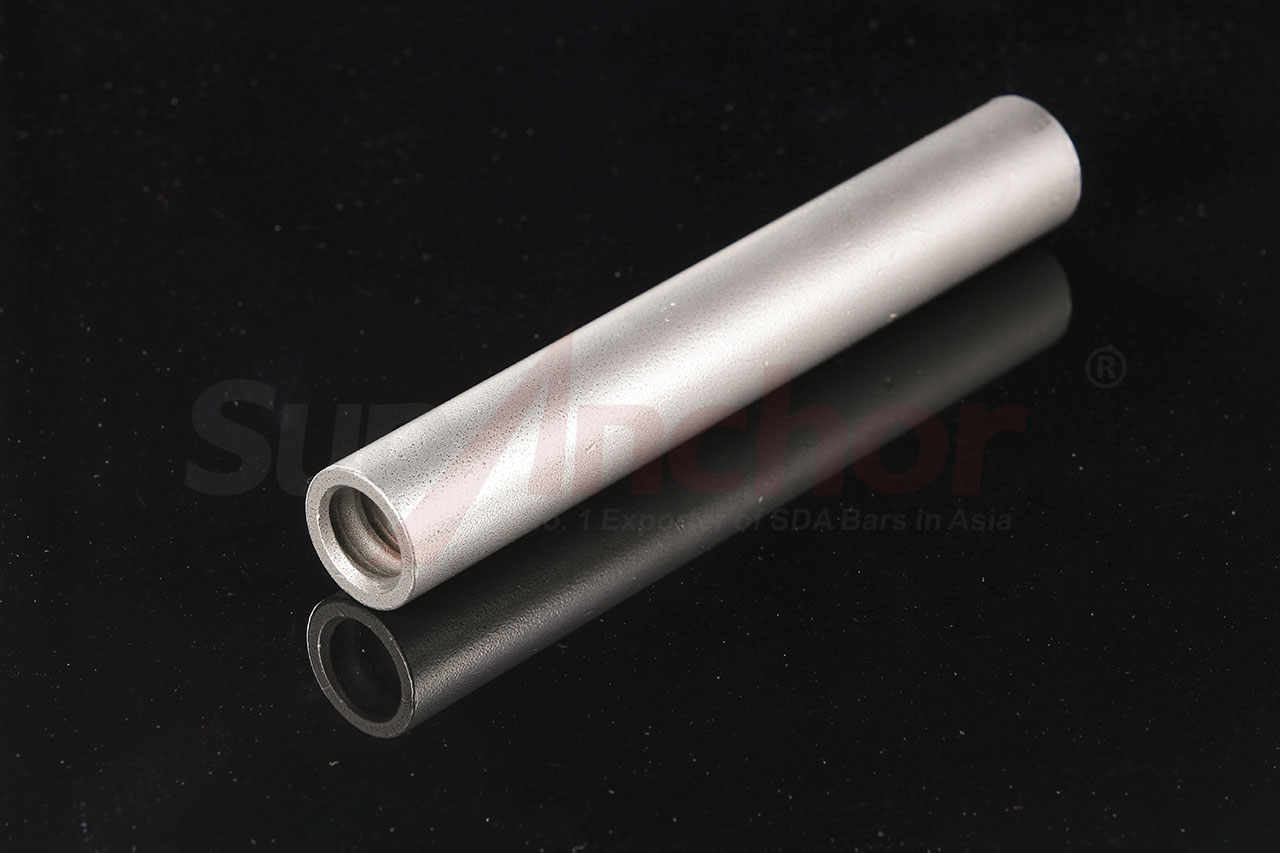
The product image above displays a standard SupAnchor self drilling anchor bolt with its distinctive thread pattern and hollow cross-section. Such anchors are produced in various diameters (25 mm, 32 mm, 38 mm, etc.) and lengths, with optional duplex coating for extreme durability. The visual confirmation of quality reinforces trust among contractors and engineers, making SupAnchor the go-to anchor bolt system for geotechnical engineering around the world.
As the global push for infrastructure modernization continues, the geotechnical reinforcement system market is projected to grow at over 6% annually. Innovations like robotic drilling and digital grout monitoring will further enhance the capabilities of self drilling anchor technology. SupAnchor is already exploring smart anchors with embedded fiber optic sensors for real-time load monitoring, signaling a new era of intelligent ground stabilization. With increasing investment in railway and highway networks across developing nations, the market for drill-and-grout bolt systems is expected to witness robust growth, and SupAnchor is poised to lead this expansion. The Trans-Alpine project stands as a beacon of what can be achieved when cutting-edge products meet real-world challenges, and it reaffirms SupAnchor's position as a leader in ground stabilization anchor systems. For any project requiring a dependable, high-performance self drilling anchor, SupAnchor's factory direct approach and proven track record make it the supplier of choice.
SupAnchor's self drilling anchor system deployed on an Alpine slope stabilization project, showcasing efficient installation and high-performance geotechnical reinforcement in challenging conditions.
SupAnchor's Grade 75 self-drilling hollow anchor bars deliver ASTM A615 performance, continuous T-thread bonding, and proven reliability for hydropower slope stabilization projects.
SupAnchor's self drilling anchor system deployed on an Alpine highway slope stabilization project, enabling fast drilling and grouting in fractured rock while meeting strict safety and environmental standards.
SupAnchor launches a corrosion-resistant GFRP friction bolt, offering lightweight, spark-free ground support for tunneling and mining.
SupAnchor's self drilling anchor system demonstrates superior performance in a challenging slope stabilization project, ensuring safety and efficiency.