
In the rugged terrain of the southern Alps, a critical highway expansion project faced daunting geological conditions: fractured rock, high groundwater pressure, and the ever-present risk of slope instability. The €480 million initiative, aimed at widening a 12-kilometer stretch to alleviate cross-border freight congestion, demanded a ground stabilization anchor system that could deliver both speed and reliability. Contractors turned to SupAnchor’s self drilling anchor system, a solution that would prove pivotal in managing the site’s complex geotechnical challenges.
The project, situated at elevations above 1,200 meters, required deep excavation support and permanent slope retention. Traditional drilling and anchoring methods were ruled out early due to the risk of borehole collapse in the highly fractured mica schist and phyllite formations. SupAnchor’s hollow bar anchor technology offered a single-pass installation: drilling, grouting, and anchoring simultaneously, eliminating the need for temporary casing and significantly reducing construction time.
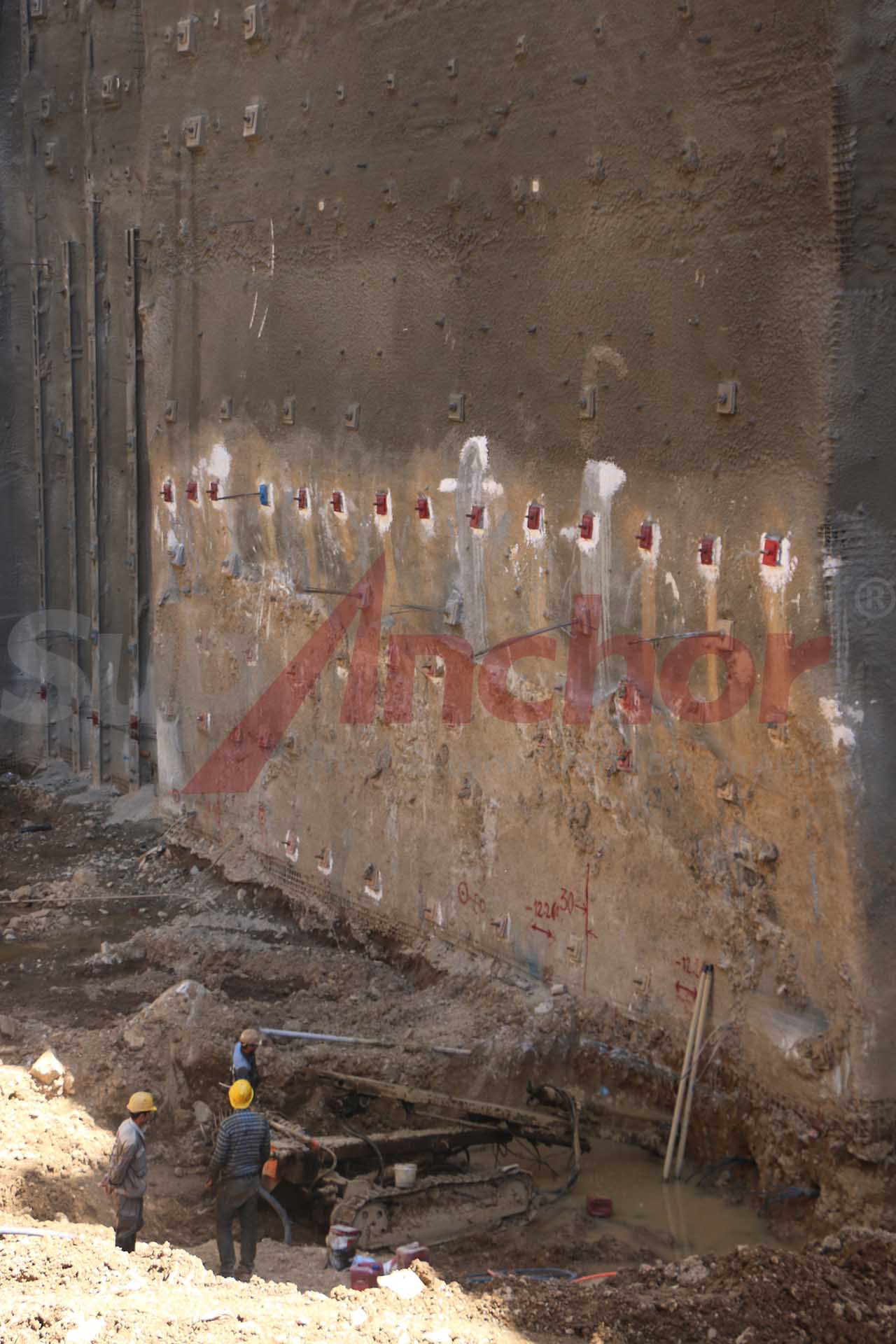
At the heart of the operation, specialized drill rigs equipped with SupAnchor SDA bolts worked along a 600-meter section of the alignment. The image captured during peak activity shows crews installing self drilling anchor bolts into a near-vertical rock face, with grout lines and hydraulic hoses weaving through the site. “The self drilling anchor system allowed us to advance the face safely, even in zones where the RQD was less than 25%,” said Dieter Lang, the project’s senior geotechnical engineer. “Without it, we would have faced weeks of delays.”
SupAnchor supplied over 15,000 linear meters of its R32 and R38 hollow bar anchors, featuring thread-like continuous ribs that maximize grout-rock bond. The system served as both temporary rock support and permanent structural element, resisting tensile loads up to 660 kN. Key technical specifications are summarized below:
| Parameter | R32 Hollow Bar | R38 Hollow Bar |
|---|---|---|
| Outer Diameter | 32 mm | 38 mm |
| Ultimate Tensile Strength | ≥ 660 kN | ≥ 850 kN |
| Yield Strength | ≥ 525 kN | ≥ 680 kN |
| Typical Length (customizable) | 3 – 12 m | 3 – 12 m |
| Corrosion Protection | Hot-dip galvanized or epoxy coating | Hot-dip galvanized or epoxy coating |
These parameters directly addressed the site’s demands: the high tensile strength accommodated design loads in unstable rock, while the customizable lengths allowed adaptation to varying drilling depths. The dual corrosion protection options—hot-dip galvanization or epoxy coating—ensured a 100-year design life in the aggressive alpine environment. As a ground anchor bolt factory, SupAnchor’s direct supply model also streamlined logistics, with bolts arriving pre-cut and ready for installation.
On-site, the drill-and-grout bolt process began with a hollow bar being rotated and percussively driven into the rock. Grout was pumped through the bar’s center, flushing debris while simultaneously filling fissures and creating a rough anchor profile that enhanced bond strength. This method eliminated the risk of borehole collapse entirely, a persistent issue in the project’s early phases. The self drilling bolt for civil engineering applications thus provided both immediate face support and long-term reinforcement.
The successful application of SupAnchor’s geotechnical reinforcement system in this European highway project underscores a global shift toward more efficient ground stabilization techniques. As infrastructure investments surge—over $3.7 trillion is projected annually in the global construction sector by 2030—the need for reliable, cost-effective anchor bolt system for geotechnical engineering has never been greater. Urban tunneling, slope remediation, and foundation support in difficult soils are driving demand for systems that can be installed quickly without compromising safety.
In hard rock tunnels and mines, the rock bolt for underground mining segment has seen steady growth, with hollow bar anchors gaining acceptance due to their rapid installation and secure bonding. Meanwhile, in retaining wall construction, the self drilling anchor for retaining walls market is benefiting from stricter building codes following high-profile slope failures in Asia and the Americas. Europe’s aging transportation infrastructure, in particular, is undergoing a wave of modernization—the alpine project being one of many where such solutions are mission-critical.
Environmental regulations also play a role: single-pass drilling reduces noise, dust, and equipment emissions compared to conventional methods. The ground stabilization anchor system employed by SupAnchor aligns with sustainability goals by minimizing material waste and site disturbance. As Dieter Lang noted, “The ecological footprint was substantially smaller, and we avoided days of helicopter slinging for casing materials.”
Behind the project’s success is SupAnchor’s two-decade track record as a leading soil nail system manufacturer and micropile hollow bar anchor specialist. Headquartered in a manufacturing hub with global distribution, the company holds ISO 9001 and ISO 14001 certifications, ensuring rigorous quality control and environmental stewardship. Its self drilling anchor bolt designs are backed by extensive laboratory tests and field validations, with a dedicated R&D team that continuously refines thread geometry and steel grades for optimal performance.
“We don’t just supply products; we deliver collaborative engineering solutions,” said Martin Weber, SupAnchor’s European technical director. “For this project, our team worked on-site during the initial 300 meters to optimize drilling parameters and grout mix, adjusting for the variable rock conditions.” This hands-on approach reflects the company’s ethos of “Professional, Innovative, Collaborative,” values that have cemented its reputation as a trusted partner to major contractors worldwide.
SupAnchor’s global footprint spans more than 40 countries, with landmark projects including metro tunnels in São Paulo, dam reinforcements in Vietnam, and slope stabilization along the Trans-Canada Highway. The company’s SDA bolt factory direct supply chain ensures competitive pricing and short lead times—a critical advantage for time-sensitive projects. By maintaining large inventories of standard hollow bar sizes and offering quick customization, SupAnchor has become a preferred anchor bolt system for geotechnical engineering firms across continents.
Looking ahead, the integration of smart monitoring technologies, such as fiber-optic sensors within the hollow bar, promises to further enhance the value of self drilling systems. SupAnchor is already piloting such innovations, aiming to provide real-time load data to improve safety and maintenance planning. As the infrastructure sector evolves, the self drilling bolt for civil engineering will remain at the forefront, and SupAnchor is poised to lead that transformation.
SupAnchor's self drilling anchor system delivers efficient ground stabilization in a large-scale infrastructure project, offering technical advantages in difficult geological conditions.
SupAnchor unveils SupFRP® GFRP reinforcement rebar offering high tensile strength, corrosion resistance, and versatility for soft-eye excavation, sea walls, and precast elements. Learn about specs and applications.
SupAnchor's self drilling anchor system has been successfully deployed on a highway slope stabilization project in Europe, overcoming fractured rock and loose soil conditions with high-strength hollow bar anchors and drill-and-grout technology.
SupAnchor launches SupFRP® GFRP friction bolt: lightweight, corrosion-resistant, non-conductive, high tensile strength, easy ore separation.
European infrastructure project overcomes difficult geology with SupAnchor self drilling anchor system. Technical specs, industry value, and brand insight.