
In the rugged terrain of the Pacific Northwest, a major highway expansion project has turned to advanced geotechnical reinforcement to secure steep slopes and ensure long-term safety. Facing fractured bedrock and high groundwater, the construction team deployed the self drilling anchor system from SupAnchor, a globally recognized soil nail system manufacturer and ground anchor bolt factory. The innovative hollow bar anchor technology allowed for rapid installation without the need for pre-drilling, significantly reducing project timelines. The $350 million interstate widening scheme, set to accommodate increased traffic between Seattle and Vancouver, encountered significant geotechnical hurdles during the excavation of large cuts in the Mount Baker foothills. Engineers discovered a highly variable geology consisting of weathered sandstone interbedded with clay seams and large boulders. Traditional drilled and grouted anchors proved impractical: cased drill holes frequently collapsed in the loose overburden, and stand-up time was minimal, leading to safety concerns and costly delays. The project’s principal contractor, in consultation with geotechnical specialists, evaluated several ground stabilization anchor system options before selecting SupAnchor’s SDA series. The self drilling anchor bolt integrated drill bit, hollow bar, and grouting capability into a single operation, eliminating hole collapse risks and enabling continuous installation through unstable ground.
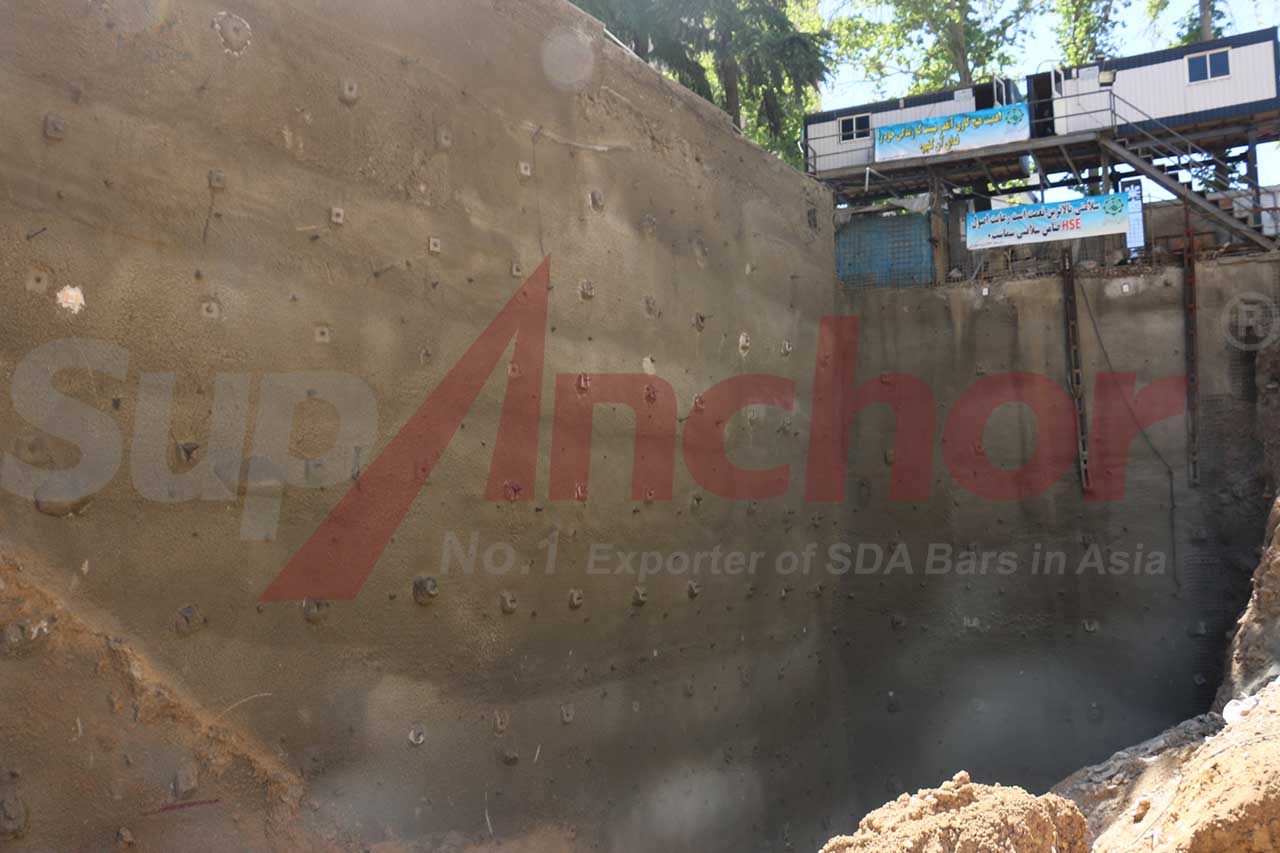
In the provided photo, crews can be seen operating a rotary drilling rig with a mast angled at 25 degrees. A self drilling anchor bolt, glistening with fresh galvanizing, extends from the drill head toward the weathered slope. The surrounding terrain is a mosaic of fractured gray sandstone and ochre‑colored clay, evidence of the folded Cascade geology. Workers in high‑visibility vests monitor grout return hoses, and a small excavator prepares the bench for the next row of anchors. The scene captures the essence of modern ground stabilization anchor system deployment—rapid, clean, and precisely controlled. The project’s design demanded a reliable geotechnical reinforcement system capable of withstanding both static and seismic loads, and SupAnchor’s engineering team worked closely with the designers to tailor the anchor bolt system for geotechnical engineering to the specific stratigraphy.
Installation commenced with track-mounted rotary percussive drills positioning the SupAnchor bars at predetermined inclinations of 15 to 30 degrees. The crew attached a disposable drill bit to the leading end of each drill-and-grout bolt and then fed the bar through the mast. As the bar advanced, neat cement grout was injected through the bar’s central hollow core, exiting near the bit and filling the annular space. This simultaneous drilling and grouting process, characteristic of the hollow bar anchor, created an immediate bond with the surrounding soil and rock. Within hours, the installed anchors could bear load, allowing subsequent slope facing and drainage measures to proceed without delay. On the most critical 80-foot-high cut, the design called for over 2,200 anchors arranged in a grid pattern, with lengths varying from 12 to 30 feet depending on the exposed material. Shorter lengths served as micropile hollow bar anchor elements for foundation support in the lower bench, demonstrating the system’s versatility.
The following table highlights key technical parameters of the SupAnchor self drilling anchor system used on this project:
| Parameter | Specification | On-Site Benefit |
|---|---|---|
| Tensile Strength | Up to 980 MPa (grade 1035 steel) | Withstands high shear and tensile loads in unstable slopes |
| Bar Diameter | 25 mm, 32 mm, 38 mm, 51 mm | Matches design load requirements; 51 mm used for deeper anchors |
| Anchor Length | Custom lengths up to 12 m (coupled sections) | Extends through loose overburden into competent rock |
| Corrosion Protection | Hot-dip galvanized (ISO 1461) or epoxy coated | Ensures 100-year design life in aggressive soils |
| Drill Bit Configuration | Cross-cut or button carbide; sacrificial | Penetrates boulders and fractured rock without bit change |
The choice of a soil nail system manufacturer with proven technology was critical: the SupAnchor self drilling anchor for retaining walls is designed with a continuous rope thread along the bar, which enhances grout bonding and allows couplers to extend lengths without reducing cross-section. This feature proved invaluable when encountering buried erratic boulders that required switching to heavier hammers and extending anchors on the fly. The contractor reported that the anchor bolt system for geotechnical engineering reduced installation time by 40% compared to conventional casing-dependent methods, while also eliminating spoils and minimizing environmental impact. Key project metrics included:
Each anchor was proof‑tested to 1.33 times the design load, with creep tests on selected anchors in clay seams confirming minimal displacement over 60‑minute holds. The data provided invaluable feedback to the design team and paved the way for potential optimization in later phases.
Throughout the project, SupAnchor provided on-site technical support, ensuring optimal grout mix designs and pull-out testing. Hundreds of verification tests confirmed that the installed anchors consistently exceeded the specified ultimate bond stress, with values above 1.2 MPa in the weathered sandstone and over 2.5 MPa in sound rock. Such performance underscores the reliability of the ground anchor bolt factory’s rigorous quality control, which includes full traceability from billet to finished bolt and conformance to EN 14490 and ASTM A432 standards.
The successful deployment on this highway project reflects a broader trend in civil engineering: the growing reliance on ground stabilization anchor systems that offer both speed and sustainability. With climate change intensifying precipitation events, slope failures have become more frequent, making robust reinforcement a priority. The self drilling bolt for civil engineering not only accelerates construction but also reduces the carbon footprint by shortening equipment hours and material waste. Unlike traditional methods that require temporary casing and often generate large spoil heaps, the SupAnchor drill-and-grout bolt leaves no excess soil or rock to be trucked off-site, aligning with green construction mandates increasingly common in European and North American infrastructure projects. A similar application of the self drilling anchor system was observed on the Eglinton Crosstown LRT tunnel in Toronto, where SupAnchor hollow bar anchors stabilized tunnel headings in flowing till. That project recorded an average installation rate of 8–10 meters per hour, a feat unattainable with conventional spiling.
Moreover, the adaptability of the system makes it ideal for complex soil conditions encountered in urban tunneling and metro expansions. The same self drilling anchor system that stabilizes a highway cut can be reconfigured as a rock bolt for underground mining or a micropile hollow bar anchor for foundation underpinning. This multipurpose nature has driven demand across multiple sectors, from transportation and energy to mining and residential development. As one of the leading SDA bolt factory direct supply sources, SupAnchor maintains ready inventory of common diameters and offers custom fabrication, ensuring that specialty anchor bolt system for geotechnical engineering solutions are only weeks away—not months.
Industry analysts point to several high-profile projects where self‑drilling anchors have become indispensable: retaining walls along the California high‑speed rail corridor, avalanche control structures in the Swiss Alps, and tunnel face stabilization in the Sydney Metro. In each case, the ability to drill and grout in one pass has reduced disturbance to fragile environments and allowed work during short weather windows. Such versatility positions the self drilling anchor bolt as a cornerstone technology for resilient infrastructure in the 21st century.
Behind every successful installation is a manufacturer committed to engineering excellence. SupAnchor, founded in 2005 and headquartered in China’s Shandong province, has grown into a premier ground anchor bolt factory supplying over 40 countries. The company holds ISO 9001:2015 certification for its quality management system, while its products carry CE and ETA approvals, affirming compliance with European Technical Assessments. From its 50,000-square-meter production facility, SupAnchor exports everything from standard rock bolt for underground mining assemblies to fully instrumented self drilling anchor for retaining walls that include load cells and corrosion monitoring sensors.
The firm’s dedicated research and development team continually refines thread geometries, steel alloys, and coating technologies. Recent innovations include a high‑ductility hollow bar anchor for seismic applications and a low‑carbon emission manufacturing process that uses electric arc furnace steel. SupAnchor’s collaborative approach—working alongside geotechnical consultants, contractors, and public agencies—has helped tailor solutions that go beyond off‑the‑shelf products. For the Pacific Northwest project, engineers from SupAnchor participated in value‑engineering workshops that optimized anchor spacing and inclination, shaving an estimated $2.1 million from the original support budget.
This partnership model reflects the company’s core values: professional expertise, innovative technology, and collaborative execution. As infrastructure demands grow more complex, SupAnchor’s soil nail system manufacturer credentials and full‑scope support—from design assistance to post‑installation testing—make it a trusted partner for projects that cannot afford failure. The SDA bolt factory direct supply model further ensures that specification‑grade materials arrive on site without intermediate markups, delivering both performance and value.
Looking forward, the industry anticipates wider adoption of ground stabilization anchor systems integrated with real‑time monitoring. SupAnchor is already piloting smart self drilling anchor bolt prototypes that embed fiber optic sensors, enabling engineers to track strain and groundwater pressure throughout a structure’s lifetime. Such advances promise to usher in an era of predictive maintenance, where infrastructure can signal its own needs long before visible distress appears. With the foundation laid on projects like the Pacific Northwest highway, the anchor bolt system for geotechnical engineering continues to evolve, setting new benchmarks for safety, sustainability, and resilience in the built environment.
SupAnchor's self drilling anchor system delivers efficient ground stabilization in a large-scale infrastructure project, offering technical advantages in difficult geological conditions.
SupAnchor unveils SupFRP® GFRP reinforcement rebar offering high tensile strength, corrosion resistance, and versatility for soft-eye excavation, sea walls, and precast elements. Learn about specs and applications.
SupAnchor's self drilling anchor system has been successfully deployed on a highway slope stabilization project in Europe, overcoming fractured rock and loose soil conditions with high-strength hollow bar anchors and drill-and-grout technology.
SupAnchor launches SupFRP® GFRP friction bolt: lightweight, corrosion-resistant, non-conductive, high tensile strength, easy ore separation.
European infrastructure project overcomes difficult geology with SupAnchor self drilling anchor system. Technical specs, industry value, and brand insight.